Top Entry Level Remote Jobs with No Experience Needed (2026 Guide)
Landing a remote job in 2026 feels a little like trying to get into an exclusive Slack workspace: everyone wants an invite, recruiters are buried under notifications, and half the job listings seem to demand three years of experience for a position that pays barely above minimum wage. Sound familiar? Welcome to the entry-level remote job market.
Here’s the plot twist: you don’t need a computer science degree, an MBA, or a LinkedIn profile that reads like a Fortune 500 success story to get your foot in the door. Companies still need people who can communicate clearly, keep operations running, handle customer issues, organize information, and help train the AI tools everyone is suddenly obsessed with.
The catch? Remote-friendly doesn’t automatically mean beginner-friendly, and entry-level doesn’t always mean easy to get hired. Employers can recruit nationwide for many work-from-home positions, which means your competition isn’t limited to candidates in your city. Your application needs to stand out, your soft skills need to translate into business value, and your job-search strategy needs more finesse than blasting out 200 identical resumes.
I’ve always thought the smartest career move isn’t chasing whichever job title is trending on LinkedIn. It’s finding a role where your existing strengths match an employer’s immediate pain points, then building a track record that makes your next promotion or career pivot easier.
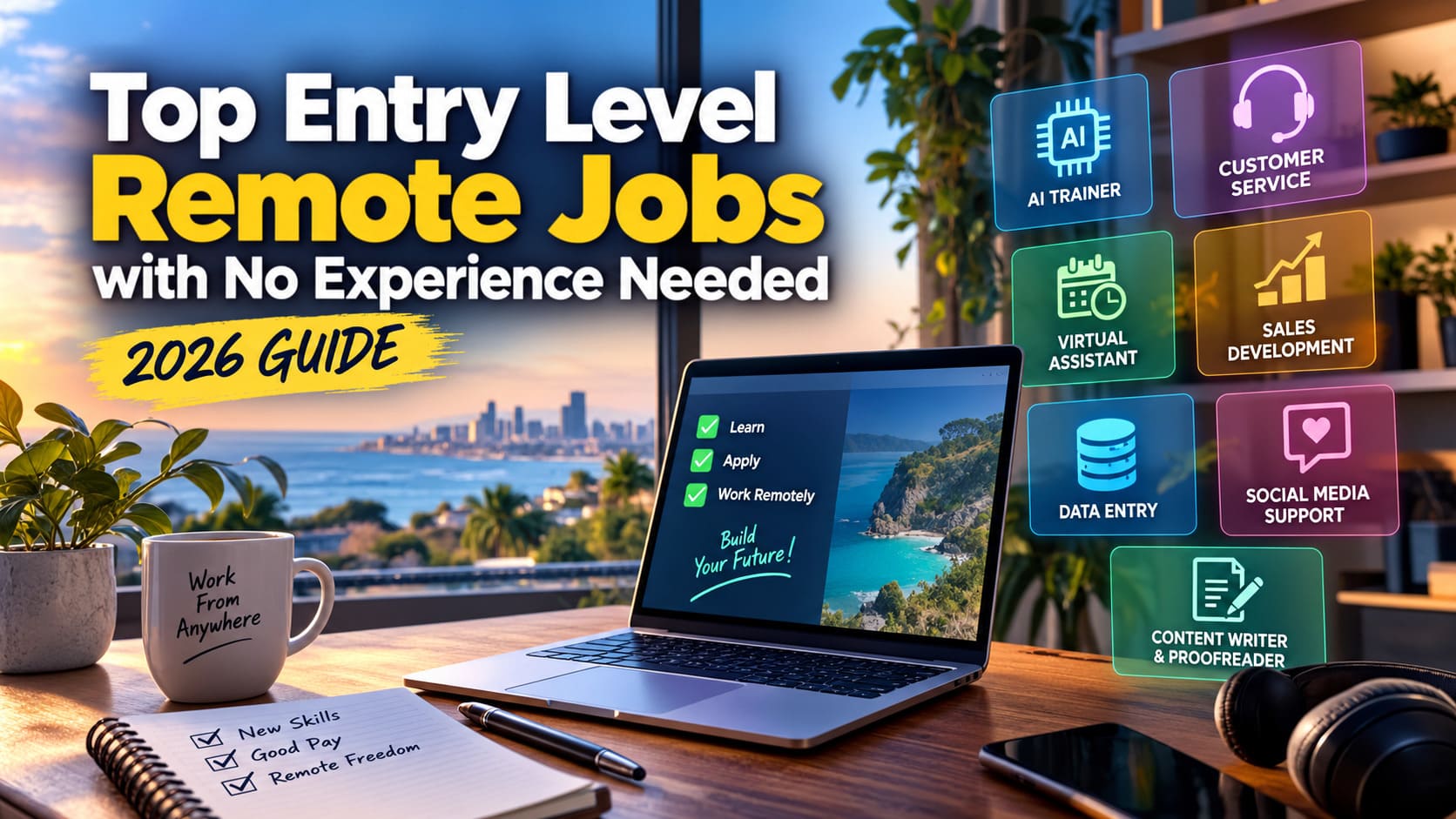
With that in mind, here are seven entry-level remote jobs worth targeting in 2026, what they actually involve, how much they might pay, and where to start your hunt.

1. AI Trainer and Data Annotator: Get Paid to Improve Artificial Intelligence
If there’s one corner of the remote job market that deserves a closer look, it’s AI training. Generative AI systems need human feedback to evaluate answers, identify mistakes, assess tone, and improve how models respond to different prompts. That creates opportunities for people with strong writing, analytical thinking, research, or language skills.
And no, you don’t necessarily need to be a developer. Many projects focus on evaluating written responses, comparing competing answers, following detailed scoring rubrics, or checking whether an AI-generated explanation makes sense.
Potential pay: Approximately $15–$45 per hour for some projects, depending on the platform, task complexity, qualifications, and available workload. These figures are indicative rather than guaranteed rates.
Companies and platforms to investigate: Outlier, DataAnnotation.tech, Appen, iMerit, and Scale AI.
Your day-to-day might involve reviewing an AI response, identifying unsupported claims, explaining why an alternative answer is stronger, and documenting your reasoning. Some projects require specialized subject knowledge, while others prioritize general writing ability and attention to detail.
My take? This is a particularly interesting entry point for people who enjoy research and don’t mind repetitive quality-control work. However, there’s a catch that job advertisements don’t always make obvious: many opportunities are freelance or project-based. Passing an assessment doesn’t guarantee a steady stream of assignments, and advertised hourly rates may not reflect the time spent qualifying for projects or waiting for available work.
How to get noticed: Practice writing clear explanations, comparing two answers against a rubric, and spotting factual inconsistencies. If you speak another language fluently or have expertise in mathematics, coding, law, or science, highlight it. Specialized knowledge can give your profile a stronger competitive edge.
2. Remote Customer Service Representative: The Reliable Entry-Level Workhorse
Customer service isn’t glamorous, but it’s one of the most practical routes into remote employment. Businesses need people who can solve problems, explain policies, process requests, and keep frustrated customers from turning a minor inconvenience into a full-blown escalation.
Many employers offer structured onboarding, scripts, knowledge bases, and supervised training. That makes customer support a realistic option for candidates without formal industry experience.
Potential pay: Around $14–$22 per hour, depending on the employer, location, schedule, and whether the role includes performance incentives.
Where to look: TTEC, Concentrix, Teleperformance, Amazon, and other companies with customer operations teams.
The job might involve handling phone calls, answering live chats, responding to emails, processing refunds, or updating customer records in a CRM system. Some positions are entirely chat-based, while others require back-to-back calls and strict adherence to performance metrics.
Here’s the underrated career upside: customer support teaches you how businesses actually operate. You learn to de-escalate conflict, document issues, navigate internal workflows, and communicate under pressure. Those skills can later translate into customer success, technical support, account management, or team leadership.
Before accepting an offer, check the fine print. Does the employer provide equipment? Is training paid? Are shifts fixed or rotating? Are weekends mandatory? Does the company monitor call handling time, customer satisfaction, or first-contact resolution?
Also, legitimate remote jobs may have geographic restrictions and specific equipment requirements. A work-from-home position isn’t necessarily a work-from-anywhere position.
3. Virtual Assistant: Become the Person Who Keeps Everything Moving
Every busy founder has a growing list of tasks that shouldn’t require their personal attention. Every small business has an inbox that gets out of control. Every overloaded executive has meetings to schedule, documents to organize, and follow-ups that somehow keep slipping through the cracks.
That’s where virtual assistants come in.
Potential pay: Approximately $15–$30 per hour, with rates varying significantly between employees, independent contractors, and experienced specialists.
Platforms to explore: BELAY, Wing Assistant, Time Etc, Upwork, and Fiverr.
A beginner VA might organize calendars, manage email, prepare meeting notes, update spreadsheets, coordinate appointments, and handle routine administrative requests. More specialized assistants may eventually take on project management, customer relationship management, bookkeeping support, or content operations.
You don’t need to arrive with a stack of certificates. You do need to demonstrate that you’re dependable, organized, discreet, and comfortable with everyday business software.
For me, this role has one of the best skill-to-opportunity ratios on the list. If you can use Google Workspace, Microsoft Office, Slack, Zoom, and a basic project management tool, you already have a foundation to build on.
Want a stronger pitch? Don’t describe yourself as someone who can simply “do admin tasks.” Position yourself as someone who helps teams reclaim time and keep deadlines on track.
A simple portfolio can make that claim more convincing. Create a sample executive calendar, a meeting agenda, a task tracker, and a professional email template. Use fictional information, package everything neatly, and show recruiters what working with you might look like.
4. Sales Development Representative: The Fast Track for Confident Communicators
If you’re comfortable starting conversations, asking questions, and handling rejection without taking it personally, remote sales could be worth a serious look.
Sales development representatives, commonly called SDRs, help generate pipeline for a company’s sales team. They contact potential customers, qualify leads, respond to inbound interest, and schedule meetings for account executives.
Potential pay: Some entry-level positions advertise base salaries around $45,000–$65,000 annually, often with additional commission. Actual compensation varies by market, company, and sales model.
Where to search: LinkedIn Jobs, ZipRecruiter, software-as-a-service (SaaS) company career pages, and specialist technology sales job boards.
The biggest attraction is the upside. A solid SDR can develop commercial awareness, negotiation skills, product knowledge, and a measurable performance record surprisingly quickly. Those achievements can support a move into account executive, account management, or revenue operations roles.
But let’s be realistic: sales isn’t an automatic money printer. Some positions have aggressive quotas, high turnover, or compensation packages that look better on paper than they feel in practice. Uncapped commission sounds exciting until you discover how difficult the quota is to reach.
During interviews, ask how many representatives hit their targets, what the ramp-up period looks like, whether leads are provided, and how commission is calculated. Find out whether training includes call shadowing, objection handling, and feedback from experienced reps.
The winning soft skill here is coachability. You don’t need to be a natural-born closer on day one. You need to absorb feedback, improve your pitch, and maintain a consistent outreach cadence.
5. Data Entry Clerk: A Straightforward Route Into Remote Operations
Not everyone wants to spend eight hours talking to customers or persuading strangers to book product demos. If you prefer structured tasks and independent work, data entry may be a better fit.
Businesses still need people to validate records, clean spreadsheets, transfer information between systems, identify duplicates, and flag inconsistencies. Automation can process large amounts of information, but poorly structured or inaccurate data creates problems that still require human oversight.
Potential pay: Approximately $14–$19 per hour for some entry-level opportunities.
Where to look: Robert Half, Indeed, Glassdoor, and legitimate administrative staffing agencies.
Typical responsibilities include entering information into spreadsheets, checking customer records, updating internal databases, and reviewing documents for accuracy. Excel or Google Sheets proficiency can help, particularly if you understand sorting, filters, basic formulas, and duplicate detection.
The downside is that pure data entry has a relatively low barrier to entry, so competition can be fierce. Some tasks are also increasingly automated, making long-term progression more attractive if you combine data entry with broader administrative or analytical skills.
My recommendation is to treat this role as a potential launchpad rather than a permanent career ceiling. Learn spreadsheet reporting, data quality control, CRM administration, or operations coordination as you gain experience.
One major warning: data entry is a favorite disguise for employment scams. Be suspicious of recruiters promising unusually high pay for minimal work, demanding upfront payments, or sending checks to purchase equipment through a designated vendor. Verify the employer and opening through its official careers page before sharing sensitive information.
6. Social Media Support Coordinator: Turn Platform Fluency Into a Business Skill
Already comfortable with Instagram, TikTok, LinkedIn, or other social platforms? You may have transferable skills that brands are willing to pay for.
A social media support coordinator usually handles the operational side of a brand’s online presence. That can mean scheduling approved posts, responding to comments, escalating customer complaints, monitoring community discussions, and preparing basic engagement reports.
Potential pay: Around $16–$25 per hour for some entry-level positions.
Companies and platforms to investigate: ModSquad, LinkedIn Jobs, digital marketing agencies, and company career pages advertising community support or content coordination roles.
Here’s where candidates often get their positioning wrong. Knowing how to post a Reel or follow a trending sound isn’t the same as managing a brand account. Employers want people who understand response times, brand voice, moderation guidelines, audience engagement, and escalation procedures.
You can demonstrate those skills without having a huge personal following.
Build a sample content calendar for a fictional brand. Draft a few customer responses in different tones. Create a simple weekly performance report and explain which metrics you’d monitor. Even a small portfolio can give recruiters something concrete to evaluate.
This role can also lead toward community management, content marketing, influencer coordination, and broader digital marketing operations. If you’re interested in creative work but don’t yet have a professional track record, it’s a useful way to start collecting measurable achievements.
7. Junior Content Writer or Proofreader: Make Your Words Work for You
If grammar, clarity, and storytelling come naturally to you, consider entry-level writing and proofreading roles.
Businesses need product descriptions, website copy, email newsletters, help-center articles, blog posts, and other content that communicates information without confusing the reader. Proofreaders focus more heavily on correcting spelling, punctuation, formatting, and consistency.
Potential pay: Approximately $15–$28 per hour for some assignments, although freelance contracts may pay per word, per project, or by another agreed arrangement.
Where to search: Digital marketing agencies, freelance marketplaces, writing job boards, and specialist proofreading businesses such as Scribendi and ProofreadingServices.com.
For writing roles, employers may ask for a sample article or a short editing exercise. You don’t necessarily need a journalism degree, but you do need to show that you can follow a brief, meet deadlines, research responsibly, and adapt your tone to the intended audience.
AI tools have changed this field considerably. Producing generic paragraphs is easier than ever, which means employers have less reason to pay a premium for undifferentiated copy. Research quality, editorial judgment, subject expertise, fact-checking, and a distinctive human voice are more valuable differentiators.
If you’re starting from scratch, prepare three strong samples: a short informational article, a product description, and an edited passage with a brief explanation of your corrections. Make sure the samples are your own work and clearly label any AI assistance where relevant.
I would also avoid relying on content mills that promise endless assignments but offer negligible compensation. A smaller portfolio of polished work can be more useful than dozens of rushed samples.
Which Remote Job Should You Target First?
The best option depends on your strengths, not whichever title has the most hype.
| Your Strongest Skill | Best Starting Point | Long-Term Direction |
|---|---|---|
| Research and analytical thinking | AI Trainer | AI evaluation, quality assurance |
| Communication and patience | Customer Service | Customer Success, Support Operations |
| Organization and reliability | Virtual Assistant | Executive Assistance, Project Coordination |
| Persuasion and resilience | Sales Development | Account Executive, Revenue Operations |
| Accuracy and consistency | Data Entry | Data Quality, Operations Analysis |
| Creativity and platform knowledge | Social Media Support | Community Management, Digital Marketing |
| Writing and attention to detail | Content Writer or Proofreader | Content Strategy, Editorial Operations |
Use this table as a starting point, not a rigid career prescription. A customer service representative with strong technical instincts may progress into IT support, while a virtual assistant who enjoys spreadsheets could move into operations analytics.
The important thing is to choose a role that provides both an attainable first offer and a credible next step.
How to Beat the Remote Hiring Funnel in 2026
Getting hired remotely is partly about qualifications and partly about execution. When an employer receives a flood of applications, a recruiter needs to identify relevant candidates quickly. Make that decision easier.
1. Build a Resume Around Evidence, Not Adjectives
Calling yourself a motivated, detail-oriented team player doesn’t tell a hiring manager much. Show how those qualities translate into work.
If you have no formal experience, draw from coursework, volunteer projects, community activities, personal projects, or previous responsibilities that demonstrate relevant skills. Never invent employers, job titles, or performance metrics.
For example, instead of writing “Good at organization,” describe how you coordinated a group project, maintained a shared schedule, or managed several deadlines simultaneously.
Keep your resume readable, use standard section headings, and tailor the skills section to the actual vacancy. A clean, concise format is generally a safer choice than a heavily designed document that might be difficult for an applicant tracking system (ATS) to parse.
2. Stop Mass-Applying and Start Matching
Submitting 100 generic applications can feel productive while delivering very little. A more targeted strategy usually gives you better control over the quality of your applications.
Search for several variations of your intended role: “remote customer support associate,” “junior operations coordinator,” “AI evaluator,” or “entry-level content assistant.” Set alerts on LinkedIn, Indeed, Remote.co, Working Nomads, and other relevant job boards.
Apply promptly when a suitable opening appears, but don’t treat the first 24–48 hours as a magical deadline. Relevance, qualifications, and the employer’s hiring process matter more than an arbitrary application countdown.
Whenever possible, verify the opening on the company’s official careers page.
3. Treat Your Soft Skills Like Hard Currency
Remote managers can’t always observe how you work throughout the day. They need evidence that you’ll communicate clearly, manage your time, flag blockers early, and deliver without constant supervision.
These aren’t fluffy resume buzzwords. They’re operational requirements.
Prepare interview stories that show how you handled a difficult conversation, learned unfamiliar software, managed competing priorities, or corrected a mistake. The STAR framework—Situation, Task, Action, Result—can help you structure those examples without sounding rehearsed.
If you’ve never held a conventional job, use honest examples from school, volunteering, personal projects, or other responsibilities.
4. Research the Employer Before You Chase the Offer
Remote-first companies such as GitLab, Automattic, Buffer, and Zapier are worth exploring, but don’t assume every opening is entry-level or available in every country. Their hiring requirements vary by team and location.
Read the job description carefully. Check whether the position is employee-based or freelance, whether benefits are included, what time zones are required, and whether the employer expects you to supply your own equipment.
During the interview, ask about onboarding, performance expectations, feedback cycles, and opportunities to learn new skills. A credible employer should be able to explain what success looks like beyond simply being online.
5. Build a Tiny Portfolio Before You Need One
A portfolio doesn’t have to be an elaborate website. One well-organized document or a small collection of sample projects can demonstrate that you’re ready to contribute.
- AI training: Show a sample evaluation rubric and explain why one response is stronger than another.
- Virtual assistance: Prepare a sample calendar, task tracker, and meeting agenda.
- Customer support: Draft responses to three hypothetical customer scenarios.
- Social media: Create a seven-day content calendar with example captions.
- Writing: Publish two or three polished samples in your chosen niche.
Use fictional data and clearly identify practice projects as demonstrations rather than paid client work. The objective is to show judgment, communication, and attention to detail—not pretend you’ve already done a job you haven’t held.
10 Best High-Paying Work From Home Jobs for Long-Term Careers in 2026
One Last Reality Check Before You Start Applying
The remote job market rewards flexibility, but flexibility shouldn’t mean accepting every offer or believing every salary claim.
Some positions advertised as remote are restricted to specific US states. Others require fixed shifts, background checks, reliable broadband, or equipment you must provide yourself. Freelance AI projects may have inconsistent workloads, and commission-heavy sales roles can produce earnings far below their advertised on-target compensation.
Always calculate the real value of an offer, including benefits, unpaid time, contractor taxes where applicable, equipment costs, and schedule requirements. Never pay an alleged employer to secure a job.
Most importantly, don’t underestimate the value of your first legitimate remote position. It can give you professional references, measurable achievements, stronger business communication, and a track record that makes the next hiring conversation easier.
The smartest play in 2026 is to stop waiting until you feel perfectly qualified. Pick one role that matches your current strengths, build a small piece of evidence that you can do the work, and apply to employers whose requirements you genuinely meet. You don’t need a perfect career history to earn your first offer. You need a credible starting point, a little persistence, and a plan that goes beyond clicking “Easy Apply.”